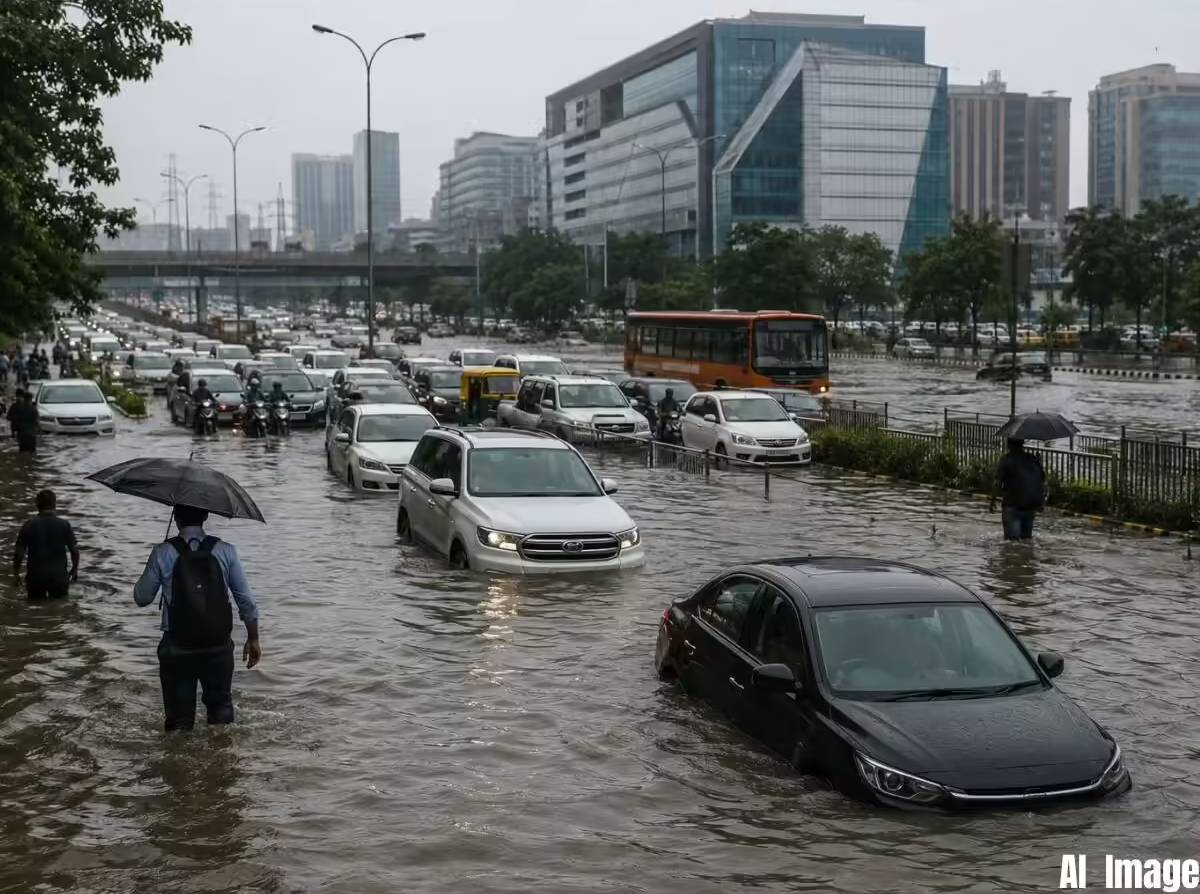
Gurgaon waterlogging 2026 hit a breaking point on July 8, when a portion of National Highway-48 near Narsinghpur caved in during heavy monsoon rain, and Gurugram Police issued a formal advisory asking companies to let employees work from home for several days. If you live in Gurgaon, none of this is surprising. If you don’t, it’s worth understanding why India’s most polished corporate hub still turns into a swamp every July.
What Actually Happened
Rain started falling hard on the morning of July 8, and by late afternoon the city had recorded close to 80 mm — enough to overwhelm roads that struggle even in a light drizzle. Delhi and Ghaziabad got hit too, with the India Meteorological Department issuing alerts across the wider Delhi-NCR region.
The real damage was structural. A section of NH-48’s Delhi-Jaipur carriageway near Narsinghpur caved in under the pressure of the rain, forcing two lanes to shut down entirely. Authorities had to redirect traffic at two of the city’s busiest intersections, Rajiv Chowk and Hero Honda Chowk, and pushed commuters coming in from Delhi toward the Dwarka Expressway instead. Underpasses and arterial roads across the city filled with water, stranding vehicles and turning a routine evening commute into a multi-hour ordeal.
The timing made things worse. The heaviest rain landed right around school dispersal time, so school buses and parents’ cars ended up stuck in the same submerged underpasses as everyone else.
The Work-From-Home Advisory
What made this round of Gurgaon waterlogging in 2026 stand out wasn’t just the flooding — it was the response. Gurugram Police issued a formal advisory asking the corporate sector to let employees work remotely for several days, citing the likelihood of continued waterlogging and gridlock. For a city whose entire economic identity is built around Cyber City, Udyog Vihar, and the Golf Course Road office corridor, that’s a significant admission: the roads simply couldn’t be trusted to move people safely.
Municipal authorities deployed tractor-mounted pumps, cranes, and recovery vehicles to key waterlogging points, prioritizing drainage and traffic flow. Additional police personnel coordinated with civic and development authorities through the worst of it.
Why Gurgaon Waterlogging Keeps Happening
Gurgaon’s flooding isn’t a one-off weather fluke — it’s a structural pattern that repeats every monsoon:
- Rapid, uneven urbanization. Much of Gurgaon was built up faster than its drainage network could keep pace with, particularly along newer corridors and sectors developed by private builders rather than a single planning authority.
- Low-lying underpasses and road design. Several of the city’s key underpasses sit below the natural water table or drainage gradient, so they fill first and drain last.
- Fragmented civic responsibility. Responsibility for roads, drains, and highways is split across multiple bodies (municipal corporation, GMDA, NHAI, and others), which can slow coordinated fixes.
- Legacy infrastructure under new pressure. A highway built for a certain traffic and rainfall load is now serving a much larger, denser city than it was designed for.
The Bigger Picture
None of this is new to Gurgaon residents — most have a personal story about being stuck for hours near a familiar underpass. What’s changed is the scale of the response: a formal WFH advisory from the police is a tacit acknowledgment that the city’s road infrastructure cannot reliably support its own workforce during monsoon season.
Gurgaon waterlogging in 2026 may keep repeating as an unofficial monsoon policy — “work from home during heavy rain” — until drainage and highway resilience catch up with the pace of the city’s growth. For related coverage, see our full guide to Gurgaon infrastructure and civic projects.
Source: The Quint — Heavy rainfall causes waterlogging in Gurugram, alerts in Delhi-NCR