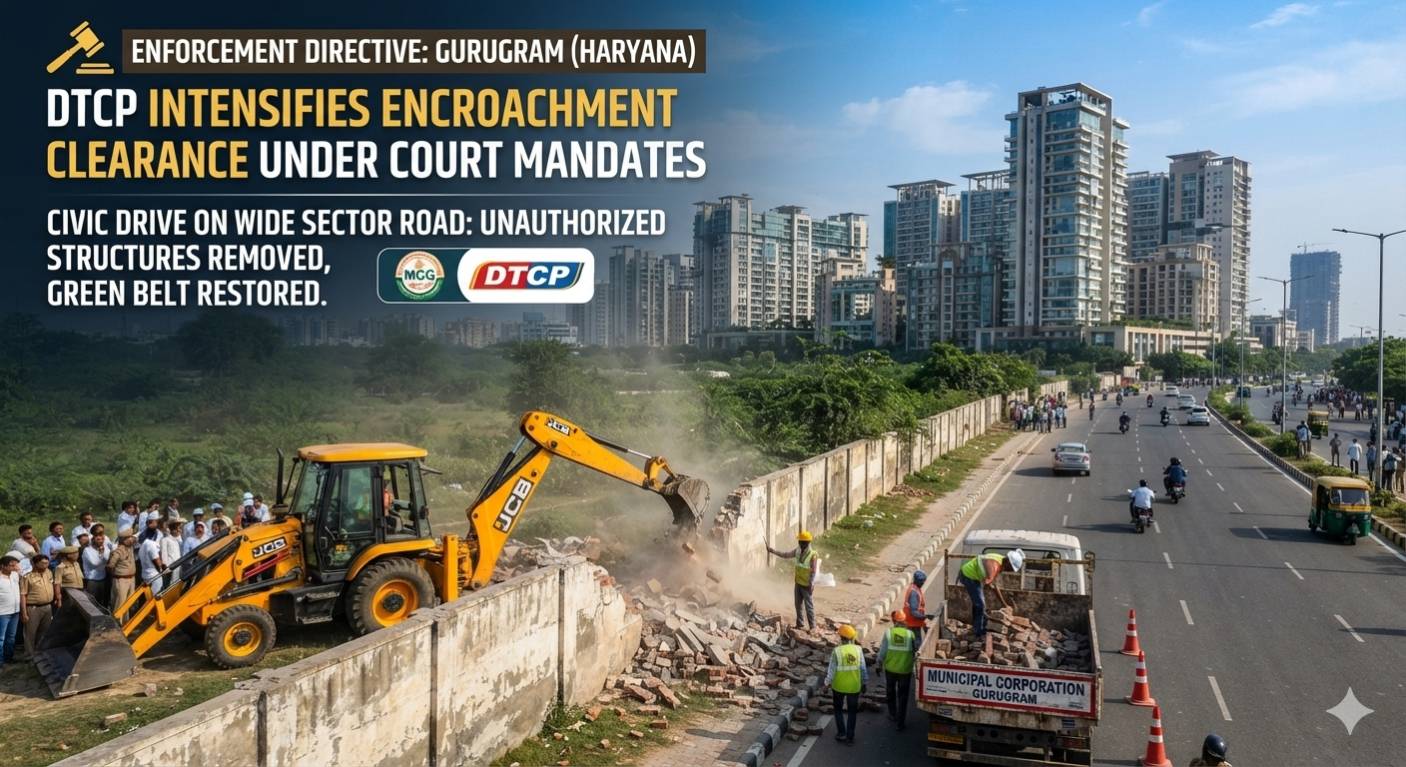
The regulatory landscape governing real estate and public land use across the National Capital Region (NCR) is shifting toward absolute structural enforcement. In an official administrative decree, the DTCP to intensify encroachment crackdown in compliance with HC, SC directives in Gurugram, systematically eliminating zoning violations, unauthorized commercial operations in residential sectors, and green belt encroachments.
Backed by direct mandates from the Punjab and Haryana High Court and the Supreme Court of India, the Department of Town and Country Planning (DTCP) enforcement wing has formulated a multi-agency strategy. For high-yield property investors, independent floor developers, and residential market analysts, this comprehensive policy deployment signals a transition away from temporary compounding penalties toward permanent physical compliance and structural clearing.
Core Breakdown: The Multi-Agency Enforcement Blueprint

The specialized clearing drives are targeting systemic violations that alter the original, state-approved town planning blueprints. Rather than focusing on single-plot minor extensions, the intensifying campaign targets long-standing violations across Gurgaon’s premium gated colonies and commercial corridors.
The primary operational metrics established under the new high-court-mandated blueprint include:
- Green Belt Reclamation: Systematically leveling unauthorized private gates, expanded boundary walls, and illegal concrete paving built over designated municipal green buffers and public park boundaries.
- Residential Zoning Audits: Launching immediate sealing actions against commercial operations—such as retail stores, illegal offices, and unauthorized PG boarding houses—operating within purely residential zones without paying conversion fees.
- Inter-Departmental Task Force Setup: Coordinating simultaneous clearance operations with the Gurugram Metropolitan Development Authority (GMDA), Municipal Corporation of Gurugram (MCG), and local law enforcement to ensure reclaimed spaces remain free from re-encroachment.
The Judicial Catalyst: Establishing Bureaucratic Accountability
The primary driver behind this sudden acceleration in municipal crackdowns is a shift in judicial enforcement strategies, placing direct personal accountability on local town planning officers.
- Strict Performance Court Reviews: Both the High Court and Supreme Court have made it clear that municipal commissioners and senior planners will face direct contempt charges if unapproved road structures or public land blockages persist under their jurisdiction.
- Mandatory Action Status Reporting: Local enforcement teams must submit bi-weekly, geotagged satellite updates directly to judicial benches, eliminating bureaucratic delays and preventing selective enforcement.
- Prioritizing Public Transit Integrity: Under the Haryana Development and Regulation of Urban Areas Act, the right-of-way on public roads, sector dividing paths, and emergency access routes is absolute and cannot be compromised by private extensions.
Pros & Cons of the Intensive Crackdown for Real Estate Portfolios
Pros
- Restores Master-Planned Integrity: Clearing public pathways and green belts directly restores the premium living environment, smooth transit networks, and aesthetic appeal promised to original township investors.
- Stabilizes Gated Condominium Values: Removing illegal commercial traffic and unauthorized high-density PGs helps lower infrastructure strain, stabilizing utility loads and maintaining high valuations for compliant properties.
- Speeds Up Road Handovers: Forcing structural compliance clears legal gridlocks, enabling faster municipal handovers and speeding up public development projects across newer growth sectors.
Cons
- Disruption in High-Yield Rental Portfolios: Investors managing unapproved commercial conversions or high-density rentals within residential sectors face immediate loss of rental income during sealing drives.
- Extended Due Diligence Windows: Secondary market property transactions may face longer processing times as banks and legal firms lengthen verification steps to ensure titles are clear of DTCP compliance reviews.
Strategic Due Diligence Guidelines for Luxury Real Estate Buyers

As enforcement tracking tightens across Gurgaon, buyers evaluating independent villas, plotted layouts, or low-rise floors must carry out thorough compliance checks to protect their investments:
- Audit Physical Dimensions Against Blueprints: Verify that the property’s physical boundaries line up precisely with the master plan layout officially approved by the DTCP Haryana.
- Inspect Right-of-Way and Easement Access: Confirm that no structural elements, parking spaces, or security cabins encroach onto municipal roads, public utility lanes, or green corridors.
- Verify Approved Commercial Licensing: If purchasing a commercial or mixed-use retail asset, request the official change of land use (CLU) certificate alongside verified municipal approvals to guarantee zoning compliance.
Concerned about upcoming zoning reviews or looking to verify the compliance status of your real estate investments in Gurgaon? Connect with our specialized compliance desk today to receive a comprehensive, independent structural record audit.
- Call / WhatsApp Us: +91-88-606060-77
- Enquire Now: Request an off-market report detailing the top 10 fully verified, litigation-free premium residential corridors in Gurgaon.