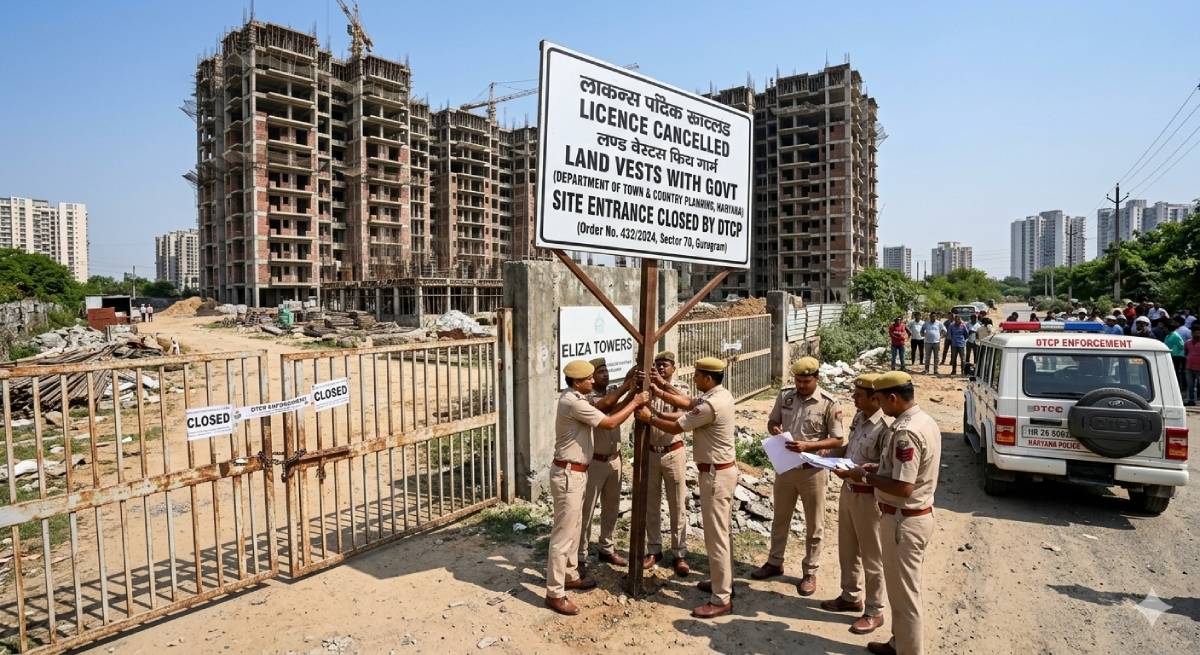
The regulatory landscape for stalled real estate developments in Millennium City has just entered a highly aggressive phase. Following up on its previous enforcement orders, the Department of Town and Country Planning (DTCP) sets takeover and asset-freeze drill for a Sector 70 project in Gurugram. The formal 11-point directive establishes a strict operational roadmap to seize control of the site, protect consumer capital, and audit the financial irregularities left behind by the defaulting developer.
For homebuyers, institutional lenders, and luxury investors tracking Gurugram real estate, this detailed enforcement drill changes the playbook for resolving distressed assets. By moving from a paper-based license cancellation to an active physical takeover, the Haryana government is setting a precedent for consumer safety across the entire NCR.
Inside the 11-Point Takeover Drill

The project under the regulatory scanner is OSB The Venetian, a 5.1-acre affordable housing complex in Sector 70, launched in September 2019 by landowners in collaboration with Ocean Seven Buildtech (OSB). After a joint inspection on July 7, 2026, found the site completely deserted, the DTCP Director officially cancelled the project’s licence on August 7, 2026, citing prolonged construction delays, outstanding external development charges (EDC) of ₹6.62 crore, and severe regulatory non-compliance.
To execute the physical transition, the Senior Town Planner (STP) has been designated as the nodal officer under Rule 19 of the Haryana Development and Regulation of Urban Areas Rules, 1976. The 11-point enforcement blueprint mandates the following on-site actions:
- Demarcation and Physical Takeover: The STP, in coordination with the district magistrate and local revenue authorities, will physically fence and take absolute possession of the licensed land and buildings.
- On-Site Asset Inventory: Enforcement squads have been authorized to conduct site drills to count, secure, and inventory all structures, machinery, and stored construction materials to prevent unauthorized removal or alteration.
- Site Warning Boards: Prominent public boards will be installed across the site coordinates stating that the developer’s licence stands cancelled, the land vests with the government, and any further transaction or alienation is strictly barred.
Complete Financial Asset Freeze Deployed
Parallel to the physical on-site drill, the DTCP has implemented a multi-agency strategy to isolate the promoter’s remaining financial channels and freeze secondary transactions.
The Sub-Registrar at Badshahpur has received direct orders to completely bar the registration of any sale deeds, leases, or title transfers involving the project’s specific Khasra numbers. Furthermore, permanent red entries are being added to the local revenue records. To protect the financial ecosystem, authorities are auditing all existing project-level mortgages, bank loans, and institutional collaboration agreements to map out the developer’s exact liabilities.
Market Implications: Resolving Stalled Projects vs. Securing Possession
While this aggressive multi-agency intervention brings a sense of relief to hundreds of distressed homebuyers, experts point out that a physical takeover is only the first step toward project revival.
| Pros of the Physical Takeover Drill | Remaining Risks and Hurdles for Allottees |
|---|---|
| Asset Preservation: Halts the siphoning of machinery, land assets, and building materials by the promoter. | Extended Timelines: Administrative handovers and technical evaluations can prolong ultimate physical possession. |
| Financial Isolation: Halts further cash collection by the default builder, saving buyers from losing more capital. | Interlocking Legal Complexity: The Enforcement Directorate’s separate provisional attachment of ₹136 crore adds layers of litigation. |
| Precedent for Capital Re-routing: Clears the path for appointing capable third-party co-developers or RWAs under Rule 19. | Liability Matching: Quantifying collected amounts vs. actual site expenditure requires intense forensic accounting. |
Critical Action Plan for Affected OSB Allottees

If you hold a residential or commercial booking within this Sector 70 development, follow this state-mandated action plan to secure your proprietary claims:
- Compile Claim Documentation: Collect your formal allotment letters, builder ledger statements, bank payment receipts, and loan transaction histories.
- Submit to the STP Nodal Officer: Watch for the public notices being published in major regional newspapers to formally log your buy-side claims with the STP’s office.
- Adhere to the Zero-Payment Warning: In line with the DTCP’s explicit public guidelines, do not make any further financial payments to the coloniser or its agents.
The Path Forward for the Gurugram Housing Market
The deployment of this asset-freeze drill signals a major shift in the Gurugram property market toward strict builder accountability. By physically seizing uncompleted assets and freezing transactions, Haryana’s town planning regulators are actively filtering out unreliable players. While this cleanup phase creates short-term noise for stalled affordable housing assets, it structurally insulates the Gurugram housing market over the long haul. Institutional global investors and individual end-users can confidently transition capital toward fully compliant, legally transparent luxury developers who deliver exactly what they advertise.
Insulate and Verify Your Property Portfolios
Navigating complex land title attachments, filing regulatory claims with nodal officers, and screening upcoming projects for default patterns requires experienced real estate expertise. If you want to identify risk-free, HRERA-compliant residential options across Gurgaon, our veteran real estate consulting team is here to assist you.
Connect with our property experts today:
📞 Call / WhatsApp us at:+91-88-606060-77
✉️ Submit an enquiry to access a curated, audited portfolio of high-yield, legally pristine property options in Gurugram.